Infrastructure-intensive industries are undergoing significant changes to embrace digital innovation. New technologies such as artificial intelligence (AI), blockchain, and the Internet of Things (IoT) are being adopted in sectors that have remained static for years.
Additionally, these industries are transitioning towards decentralized models. Consequently, decentralized physical infrastructure, or DePINs, are rapidly gaining momentum.
According to a new report from Moody’s Ratings, titled “How DePINs could build the future of physical infrastructure one token at a time,” the DePIN market has the potential to reach $3.3 trillion by 2030. Findings show that this market was valued at $2.2 trillion last year.
DePIN For The Auto Industry Explained
While the concept behind DePIN may seem complex, billion-dollar industries like the automotive sector are beginning to show the transformative potential of these models.
Early use cases demonstrate how car owners can manage and monetize their data while receiving incentives for sharing personal information.
For instance, Dimo is a DePIN network designed to enhance the car ownership experience. Rob Solomon, Co-Founder of Dimo, explained that Dimo aims to make every car smart and programmable by integrating vehicles on-chain.
“Dimo works by giving vehicles an on-chain identity,” Solomon said. “Users mint their vehicle on-chain to create a digital twin of the car. We then connect the digital car to the Dimo platform via a vehicle ID.”
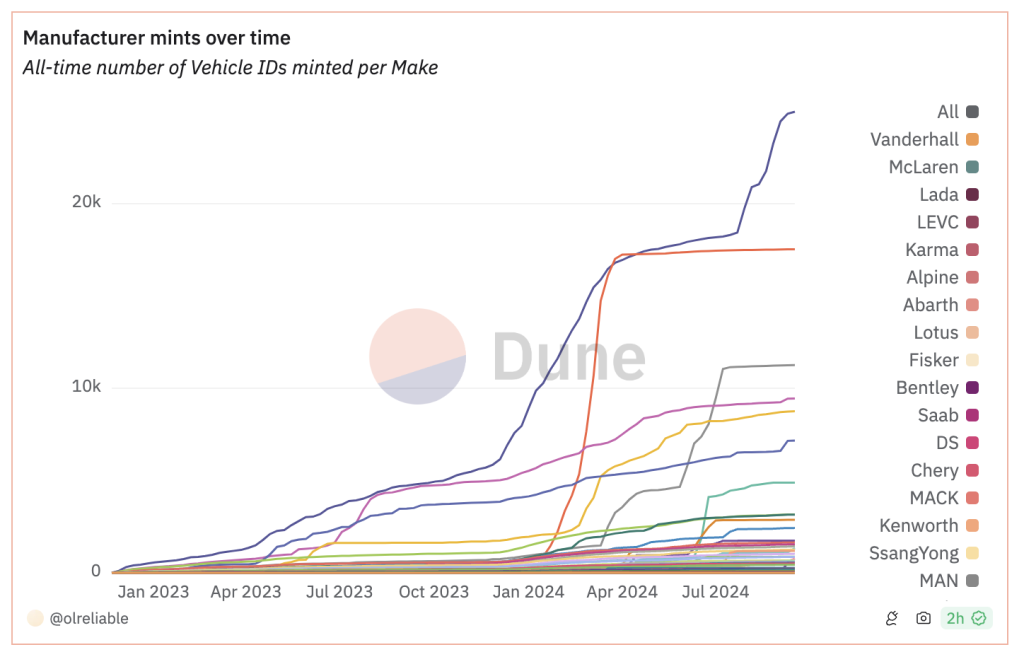
Solomon noted that data generated from a user’s car is recorded off-chain, including speed, location, and other information.
Users can choose to share their data with Dimo in exchange for tokens as an incentive.
“The Dimo token is live, and anyone who connects their car automatically earns Dimo tokens weekly as a baseline reward,” Solomon said. “Users can also share their data to earn additional rewards that go directly to the Dimo wallet.”
According to the Dimo protocol dashboard, 112,311 cars are connected to Dimo, with over 36,000 vehicle ID holders.
User Data Streamlines The Auto Industry
While drivers can earn passive income by connecting their cars to Dimo, the data generated can streamline traditional processes within the auto industry.
Solomon believes that Dimo will enable new types of use cases for companies over time.
For example, he mentioned car insurance agencies partnering with Dimo to access data from the platform.
“Insurance companies can’t access important data from drivers and their vehicles, so they are looking for a better way to connect with users. They see Dimo as a way to do this,” he said.
Another potential use case Solomon mentioned is having cars connect directly to parking garages.
“Once a vehicle enters a garage, a payment will already be secured, and the car will know exactly where to park,” he noted.
Car Data Helps With Mapping Accuracy
Another interesting automotive DePIN use case is being enabled by a street-level mapping project called Hivemapper Network.
Ariel Seidman, Co-founder of Hivemapper Network and CEO of the Bee Maps brand, explained that Hivemapper contributors could help build digital maps by collecting high-quality, street